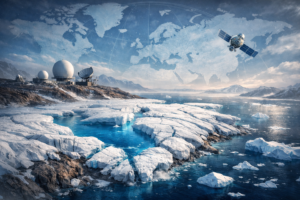
For decades, Greenland sat quietly on the edges of global attention—vast, icy, and remote, known mostly for glaciers, polar bears, and Indigenous Inuit culture. Yet in recent years, this enormous Arctic island has re-emerged as a focal point of international debate. Headlines mention Greenland not only in discussions about climate change, but also in connection with global power politics, military strategy, rare earth minerals, and, unexpectedly, former U.S. President Donald Trump.
When Trump first suggested in 2019 that the United States should “buy” Greenland, the idea was widely mocked as bizarre or unserious. However, years later, Greenland continues to dominate strategic conversations in Washington, Beijing, Moscow, and Brussels. Trump’s renewed interest—alongside rising geopolitical tensions—signals something far more significant than a casual remark. Greenland is no longer just an icy landmass; it is a geopolitical chessboard.
This article explores why Greenland is back in the news, what makes it strategically critical, and why Donald Trump—and other global leaders—see it as a prize worth talking about.
Understanding Greenland: Geography, Politics, and Identity
Greenland is the world’s largest island, covering over two million square kilometers, yet home to only about 56,000 people. Roughly 80 percent of its surface is covered by ice, making it one of the most extreme environments on Earth. Politically, Greenland is an autonomous territory within the Kingdom of Denmark. While Denmark handles defense and foreign policy, Greenland controls its internal governance and has been gradually seeking greater independence.
The population is predominantly Inuit, with a strong cultural identity and growing political consciousness. Many Greenlanders view their future as distinct from Denmark, though economic dependence—particularly on Danish subsidies—remains a major constraint.
For most of modern history, Greenland’s remoteness insulated it from global power struggles. That insulation is now gone.
Climate Change: The First Trigger of Global Attention
One of the most important reasons Greenland is back in the news is climate change. Rising global temperatures are melting Greenland’s ice sheet at an alarming rate. Scientists warn that Greenland’s ice melt alone could raise global sea levels by several meters over time, threatening coastal cities worldwide.
But climate change is not only an environmental crisis—it is also a geopolitical one.
As ice retreats, new shipping routes, previously inaccessible natural resources, and strategic waterways are opening up in the Arctic. Greenland, located between North America and Europe, sits at the heart of this transformation.
The melting ice has effectively turned Greenland from a frozen backwater into a gateway.
Greenland’s Strategic Location: The Arctic Crossroads
Greenland’s geographical position is its greatest asset—and its greatest vulnerability.
Situated between the Arctic Ocean and the North Atlantic, Greenland lies along the shortest route between North America and Europe. This makes it critically important for:
- Missile defense systems
- Early warning radar installations
- Military aircraft transit routes
- Naval operations in the Arctic
The United States recognized this importance during World War II, establishing military bases in Greenland to counter Nazi Germany. During the Cold War, Greenland became a frontline outpost against the Soviet Union.
That strategic logic has returned—only this time, the rivals are not just Russia, but also China.
The U.S. Military Presence in Greenland
The United States already maintains a significant military footprint in Greenland through Pituffik Space Base (formerly Thule Air Base). This installation is essential for:
- Ballistic missile early warning systems
- Space surveillance
- Arctic military operations
As global tensions rise and hypersonic missile technology advances, early detection systems in the Arctic have become more valuable than ever. Any missile launched from Russia toward North America would likely pass over or near Greenland.
From a defense standpoint, Greenland is not optional—it is essential.
Rare Earth Minerals: Greenland’s Hidden Wealth
Another major reason Greenland is in the spotlight is its untapped mineral wealth.
Greenland is believed to contain large deposits of:
- Rare earth elements
- Uranium
- Zinc
- Gold
- Iron ore
Rare earth minerals are critical for modern technologies, including smartphones, electric vehicles, wind turbines, and military equipment. Currently, China dominates the global supply chain for rare earth elements, giving Beijing enormous leverage over other countries.
Western nations are desperate to diversify supply chains, and Greenland represents one of the few viable alternatives.
This economic reality transforms Greenland from a frozen island into a strategic resource hub.
China’s Interest in Greenland
China’s growing interest in Greenland has deeply concerned the United States and its allies.
Over the past decade, Chinese companies have explored investments in Greenlandic mining projects and infrastructure development, including airports and ports. While these projects were framed as economic partnerships, Western analysts viewed them as part of China’s broader Arctic strategy.
China has declared itself a “near-Arctic state,” a term that raised eyebrows in Washington and Copenhagen alike. Control or influence over Greenland would give China a foothold in the Arctic—something the U.S. sees as unacceptable.
It is within this context that Trump’s remarks begin to make more sense.
Trump’s Greenland Proposal: Not as Crazy as It Sounded
When Donald Trump floated the idea of buying Greenland in 2019, the global reaction was swift ridicule. Danish officials called the proposal “absurd,” while commentators mocked Trump as unserious.
However, history offers important context.
The United States has purchased territory before—Louisiana from France, Alaska from Russia, and the U.S. Virgin Islands from Denmark. From a purely historical and strategic perspective, Trump’s idea was not unprecedented.
What made it controversial was not the concept itself, but the blunt, transactional way it was expressed.
Behind the headlines, Trump’s proposal reflected genuine strategic anxieties within the U.S. defense establishment.
Why Trump Is Talking About Greenland Again
Trump’s renewed rhetoric around Greenland aligns with broader themes in his foreign policy worldview:
- America First Strategy
Trump consistently views international relations through a lens of competition and advantage. Greenland’s resources and location fit squarely into that framework. - Countering China
Trump’s presidency marked a sharp escalation in U.S.–China rivalry. Preventing Chinese influence in Greenland is consistent with that agenda. - Military Dominance
Trump prioritized military strength and strategic positioning. Greenland enhances U.S. control over Arctic and transatlantic defense corridors. - Economic Nationalism
Access to rare earth minerals aligns with Trump’s desire to reduce U.S. dependence on foreign supply chains.
In this sense, Greenland is not an anomaly in Trump’s thinking—it is a logical extension of it.
Denmark’s Response and European Concerns
Denmark has firmly rejected any notion of selling Greenland, emphasizing that Greenlanders themselves have the right to determine their future.
European leaders are wary of turning the Arctic into a new arena of great-power confrontation. However, Europe also recognizes the strategic stakes. NATO allies increasingly coordinate Arctic defense policies, acknowledging that Greenland’s security is inseparable from Europe’s own.
At the same time, Denmark faces a delicate balancing act: protecting sovereignty, respecting Greenlandic autonomy, and managing pressure from powerful allies.
Greenland’s Own Perspective: Independence and Caution
Greenlanders themselves are not passive spectators in this drama.
There is a growing movement within Greenland favoring eventual independence from Denmark. Many see economic development—especially mining—as a path toward self-sufficiency.
However, Greenlandic leaders are cautious. They understand that foreign investment often comes with political strings attached. Allowing excessive influence from any one power—whether the U.S., China, or others—could undermine Greenland’s long-term autonomy.
For Greenlanders, the challenge is clear: how to benefit from global interest without becoming a pawn in a geopolitical game.
Russia and the Arctic Militarization
Russia is another key factor in Greenland’s resurgence.
Moscow has been expanding its Arctic military infrastructure, reopening Soviet-era bases, deploying icebreakers, and strengthening its Northern Fleet. Russia views the Arctic as central to its national security and economic future.
This militarization heightens U.S. concerns and reinforces Greenland’s importance as a counterbalance. The Arctic is no longer a frozen buffer—it is a contested frontier.
The Arctic as the Next Global Power Arena
Taken together, climate change, resource competition, and great-power rivalry are transforming the Arctic into one of the most strategically significant regions of the 21st century.
Greenland stands at the center of this transformation.
What once seemed like an obscure island is now:
- A frontline of climate science
- A hub for future shipping routes
- A storehouse of critical minerals
- A military vantage point between superpowers
In this context, Trump’s focus on Greenland appears less eccentric and more prescient.
Media Narratives vs. Strategic Reality
Much of the public discourse around Greenland has focused on Trump’s personality rather than the underlying issues. This has obscured the deeper reality: multiple U.S. administrations, regardless of party, recognize Greenland’s strategic importance.
Even after Trump left office, the Biden administration increased diplomatic engagement with Greenland, reopened a U.S. consulate, and expanded Arctic cooperation.
This continuity underscores a key point: Greenland matters, regardless of who is president.
What the Future Holds for Greenland
Greenland’s future will likely be shaped by three competing forces:
- Global demand for resources
- Rising geopolitical competition
- Greenlandic aspirations for autonomy and sustainability
How these forces interact will determine whether Greenland becomes a model of balanced development or a flashpoint of international tension.
The world is watching—and so are global powers.
Conclusion: Greenland Is No Longer Invisible
Greenland’s return to the headlines is not accidental, nor is it temporary. It reflects profound shifts in the global order.
Donald Trump’s comments, while controversial, served as a blunt reminder of what many policymakers already understood: Greenland is strategically invaluable. Its location, resources, and role in Arctic security make it a key asset in an increasingly competitive world.
As climate change reshapes geography and geopolitics alike, Greenland stands as a symbol of the new global reality—where even the most remote corners of the planet can become central to power, politics, and the future of international relations.
Greenland is no longer invisible. And it is unlikely to leave the news anytime soon.
Products:
- iphone Smart Watch for Women
- Astronaut Adventures: A Space Coloring Journey
- PlayStation 5 Digital Edition
- Resistance Loop Exercise Bands
- Cetaphil Face & Body Moisturizer