Anyone who has lived in or traveled between India and Western countries—or even parts of East Asia—has likely noticed a striking difference in everyday public behavior. Simple acts such as standing in a queue, following traffic rules, maintaining public cleanliness, or respecting shared spaces often feel fundamentally different abroad compared to India. This contrast is commonly described as a “gap in civic sense.”
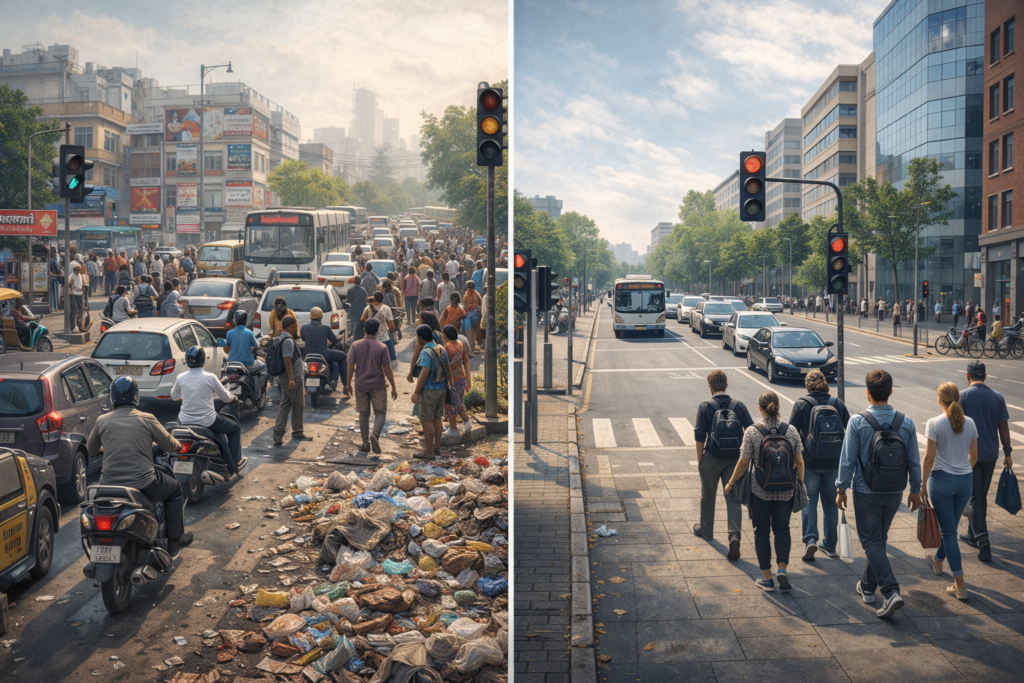
But why does this gap feel so wide? Is it really about culture, or are deeper structural, historical, and institutional factors at play?
This article examines what civic sense truly means, how it manifests differently in India and abroad, and why the difference persists despite education, globalization, and modernization.
What Is Civic Sense?
Civic sense refers to the collective behavior of citizens in public spaces that reflects responsibility, respect for others, and adherence to shared rules. It includes:
- Following laws and regulations
- Respecting public property
- Maintaining cleanliness
- Showing consideration for others in shared environments
- Participating constructively in civic life
Civic sense is not merely about personal morality. It is about how individuals behave when their actions affect strangers and society as a whole.
The Everyday Contrast: India vs Abroad
The contrast between India and many developed countries becomes most visible in everyday situations:
- Traffic behavior: Lane discipline, pedestrian right-of-way, and rule enforcement are often stronger abroad.
- Public cleanliness: Littering is socially unacceptable in many countries, while it remains common in India.
- Queue discipline: Standing in line is strictly followed abroad; in India, it is often flexible or ignored.
- Noise levels: Public noise is regulated and socially discouraged abroad, whereas it is frequently tolerated in India.
These differences are not imagined. They are observed repeatedly by Indians living abroad and foreigners visiting India.
Is Culture Really the Main Reason?
Culture is often blamed as the primary explanation, but this is an oversimplification.
Indian society places strong emphasis on family, community, and interpersonal relationships. However, civic behavior requires a sense of responsibility toward unknown others—people outside one’s immediate social circle.
In many Western societies, civic behavior evolved around the idea of the individual as a citizen, not just as a family or community member. In India, social responsibility historically operated within caste, village, or religious boundaries rather than abstract civic institutions.
This does not mean Indian culture lacks values. It means those values evolved in a different social structure.
The Role of Population Density
One cannot discuss civic sense in India without acknowledging population pressure.
India’s cities are among the most densely populated in the world. When public spaces are overcrowded, competition replaces cooperation. People adapt survival-oriented behaviors—pushing ahead, bending rules, prioritizing personal convenience.
In contrast, many developed countries have:
- Lower population density
- Better urban planning
- More public infrastructure per capita
When systems function smoothly, people are more willing to follow rules. When systems feel broken, rule-breaking becomes normalized.
Weak Enforcement and Selective Accountability
One of the most critical reasons for the civic gap is law enforcement.
In many countries abroad:
- Rules are consistently enforced
- Penalties are predictable
- Social status rarely overrides legal consequences
In India:
- Enforcement is inconsistent
- Violations often go unpunished
- Influence, money, or connections can override rules
When people observe that rules are optional and consequences avoidable, civic discipline erodes. Over time, non-compliance becomes rational behavior rather than moral failure.
Education Without Civic Training
India produces millions of graduates every year, yet civic behavior often remains weak. This highlights a key issue: education without civic conditioning.
Most Indian education systems focus heavily on:
- Exams
- Rote learning
- Career outcomes
Very little emphasis is placed on:
- Public responsibility
- Civic duties
- Behavioral ethics in shared spaces
In many countries abroad, civic education starts early, reinforcing ideas such as:
- Public property belongs to everyone
- Rules exist for collective benefit
- Individual actions have social consequences
Civic sense is trained, not assumed.
Colonial Legacy and Distrust of Institutions
India’s relationship with public institutions was shaped by colonial rule. Under British administration, laws and systems were designed to control rather than serve the population.
As a result:
- Rules came to be seen as external impositions
- Public property felt “government-owned,” not “people-owned”
- Evading authority became a survival skill
In contrast, countries that developed institutions organically often fostered public trust in governance systems. When citizens trust institutions, they cooperate with them.
The “Chalta Hai” Mindset
A frequently cited phrase in Indian public discourse is “chalta hai” (it’s okay, let it be). This mindset reflects social tolerance for small rule violations.
While flexibility can be a strength in personal relationships, it becomes a weakness in civic systems. When small violations are ignored, larger ones follow.
Abroad, social pressure discourages even minor civic misconduct. In India, social pressure often discourages confrontation, allowing violations to continue unchecked.
Infrastructure and Civic Behavior: A Two-Way Relationship
Civic sense and infrastructure reinforce each other.
In many Indian cities:
- Public toilets are insufficient or poorly maintained
- Waste disposal systems are inadequate
- Footpaths are encroached or nonexistent
When infrastructure fails, citizens adapt in undesirable ways. Over time, these adaptations harden into habits.
However, infrastructure alone is not enough. Countries with excellent infrastructure also enforce rules strictly, creating a feedback loop between behavior and system quality.
Why Indians Behave Differently Abroad
A common observation is that Indians often follow rules diligently when living abroad. This challenges the idea that Indians inherently lack civic sense.
The reason is simple:
- Rules abroad are enforced
- Violations carry real consequences
- Social norms discourage misconduct
Behavior changes when incentives and penalties change. Civic sense is situational as much as it is cultural.
Media, Role Models, and Public Behavior
Public figures play a significant role in shaping civic norms.
In India, politicians, celebrities, and public officials are frequently seen violating rules without consequences. This normalizes misconduct and signals that civic discipline is optional.
In many countries abroad, public figures are held to higher standards, and scandals over minor violations can end careers. Accountability sends a powerful message.
Civic Sense and Economic Development
Economic insecurity also affects civic behavior.
When people struggle for basic needs:
- Long-term collective interests take a back seat
- Rule-breaking becomes a coping mechanism
As societies become more economically stable, citizens are more willing to invest emotionally in public order and shared spaces.
However, economic growth alone does not guarantee civic improvement without institutional reform.
Can the Gap Be Reduced?
The gap in civic sense between India and abroad is not permanent. It can be narrowed through:
- Consistent law enforcement
- Early civic education in schools
- Improved urban infrastructure
- Public accountability for leaders
- Community-based behavioral campaigns
Countries that improved civic behavior did so over decades, not overnight.
A Matter of Systems, Not Superiority
It is important to avoid framing the issue as moral superiority versus inferiority. Civic sense is largely a product of systems, incentives, enforcement, and social conditioning.
Indians are not less disciplined by nature. They operate within environments that often reward non-compliance and punish honesty.
Change requires structural reform, not cultural self-loathing.
Conclusion: Civic Sense Reflects Governance, Not Genetics
The wide-felt gap in civic sense between India and many countries abroad is real, but it is also explainable—and fixable.
Civic behavior flourishes where:
- Rules are clear
- Enforcement is fair
- Institutions are trusted
- Citizens feel ownership of public spaces
As India modernizes, urbanizes, and reforms governance, civic sense will evolve alongside it. The question is not whether Indians can match global civic standards, but whether systems will allow and encourage them to do so.
Civic sense is not a character flaw. It is a mirror reflecting how a society is organized, governed, and valued.
Products:-
- Shark Robot Vacuum & Mop Combo
- Shark Flex Style Air Styling & Drying System
- Shark Hair Dryer Speed style Rapid gloss Finisher
- Shark Air Purifier for Home
- Shark Portable Spot, Stain, & Odor Remover