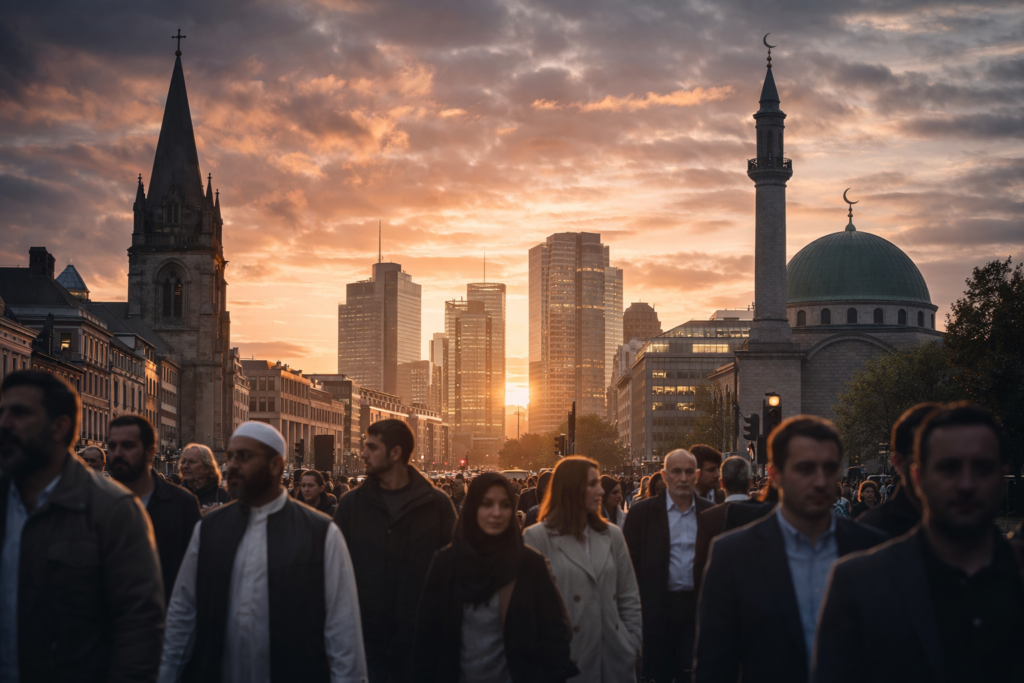
Over the past few decades, Western societies have been undergoing profound cultural, demographic, and ideological changes. At the heart of these transformations lies an increasingly visible tension between three powerful worldviews: Islam, Christianity, and secularism. Each offers a distinct vision of morality, law, identity, and social organization. As these visions interact—sometimes peacefully, sometimes contentiously—they shape political debates, public policy, and everyday life across Europe and North America.
This article explores how these three belief systems coexist, compete, and conflict in the modern West, and why their interaction has become one of the defining issues of the 21st century.
The Historical Role of Christianity in the West
For centuries, Christianity was the moral and cultural foundation of Western civilization. European laws, social norms, holidays, education systems, and political institutions were deeply influenced by Christian theology and ethics. Concepts such as the sanctity of life, charity, forgiveness, individual conscience, and moral accountability were shaped by Christian doctrine.
Even as Enlightenment thinking challenged religious authority, Christianity continued to provide a moral framework for Western societies. Churches were not only places of worship but also centers of community life, education, and social welfare. Many modern democratic values—such as human dignity and equality before the law—emerged within a Christian-influenced philosophical context.
However, the latter half of the 20th century saw a sharp decline in religious observance, particularly in Europe. Church attendance dropped, religious education weakened, and Christianity gradually shifted from a dominant public force to a more private matter of personal belief.
The Rise of Secularism as a Dominant Ideology
Secularism emerged as a response to religious authority, aiming to separate faith from governance and public institutions. In theory, secularism promotes neutrality, allowing people of all beliefs—or none—to coexist under a shared legal and political system.
In practice, secularism in the West has evolved beyond neutrality. It has increasingly become an ideological framework of its own, emphasizing rationalism, individual autonomy, personal freedom, and moral relativism. Traditional religious values are often viewed as outdated or restrictive, especially in debates around gender, sexuality, family structures, and education.
As Christianity retreated from public life, secular norms filled the vacuum. Governments reduced the influence of religious institutions, public spaces became less faith-oriented, and policy-making relied more on scientific, legal, and economic reasoning than moral or theological considerations.
Yet secularism has not fully replaced the human need for meaning, identity, and moral certainty—creating space for alternative belief systems to gain influence.
Islam’s Growing Presence in Western Societies
Unlike Christianity, which has largely adapted to secular norms, Islam often maintains a strong connection between faith, law, and daily life. For many Muslims, religion is not limited to personal spirituality but extends into social behavior, family structure, and moral obligations.
Mass immigration from Muslim-majority countries since the late 20th century has significantly increased the Muslim population across Western Europe and parts of North America. Cities such as London, Paris, Berlin, and Brussels now host large and visible Muslim communities, complete with mosques, Islamic schools, cultural centers, and religious organizations.
For many Western societies, this demographic shift has introduced new cultural dynamics. Questions around religious dress, halal food, prayer spaces, Sharia councils, and faith-based education have become part of public debate. Supporters argue that religious freedom must apply equally to Islam, while critics raise concerns about integration, social cohesion, and conflicting value systems.
Differing Views on Law and Authority
One of the key areas of tension between Islam, Christianity, and secularism lies in their approach to law and authority.
- Christianity, in its modern Western form, generally accepts secular legal systems while maintaining moral teachings within the church and personal life.
- Secularism insists that laws should be based on universal, non-religious principles, applying equally to all citizens regardless of belief.
- Islam, in many interpretations, does not fully separate religious principles from social or legal conduct, which raises concerns when Islamic norms appear to challenge secular laws.
These differences have fueled debates over issues such as freedom of speech, blasphemy, women’s rights, LGBTQ+ rights, and the limits of religious accommodation.
Identity, Belonging, and Cultural Anxiety
Beyond legal and political debates, the interaction of these worldviews affects identity and belonging. Many Western citizens feel that their cultural heritage—shaped historically by Christianity—is being eroded, not only by secularism but also by the growing influence of Islam.
At the same time, many Muslims feel marginalized, stereotyped, or excluded from mainstream society. This mutual sense of alienation has contributed to polarization, with far-right movements exploiting fears of cultural loss and Islamist groups capitalizing on feelings of discrimination.
Christian communities, meanwhile, often feel caught in between—losing influence in a secular public sphere while watching another religious identity gain visibility.
Media, Politics, and the Amplification of Conflict
Modern media plays a significant role in shaping perceptions. High-profile incidents involving extremism, hate speech, or religious controversy receive disproportionate attention, reinforcing stereotypes and fear on all sides.
Political actors frequently weaponize these tensions for electoral gain. Some present Islam as an existential threat, while others dismiss all concerns as intolerance. Similarly, secularism is either portrayed as liberation or as moral decay, depending on the ideological lens.
This environment leaves little room for nuanced discussion, making genuine dialogue increasingly difficult.
Can These Visions Coexist?
The central question facing Western societies is not whether Islam, Christianity, and secularism exist—but how they can coexist.
A stable future likely depends on several factors:
- Clear boundaries between religious belief and state authority
- Equal application of laws without privileging or targeting any faith
- Respect for freedom of belief alongside protection of individual rights
- Honest discussion about integration, values, and social expectations
Ignoring tensions does not resolve them, but framing them as inevitable conflicts risks deepening divisions.
The Road Ahead for the West
The West stands at a crossroads. Secularism remains the dominant institutional framework, but it faces growing challenges from both religious revival and cultural fragmentation. Christianity continues to influence Western identity, even as its institutional power declines. Islam is becoming a permanent and influential presence, reshaping cultural landscapes and public discourse.
How these competing visions evolve will shape not only politics and policy, but the very meaning of Western identity in the decades to come. The challenge lies in balancing diversity with cohesion, freedom with responsibility, and belief with shared civic values.
Conclusion
Islam, Christianity, and secularism represent three competing yet interconnected visions shaping the modern West. Their interaction reflects deeper questions about identity, morality, authority, and the future of pluralistic societies.
Understanding these dynamics requires moving beyond slogans and fear-driven narratives. Only through informed, balanced, and honest dialogue can Western societies navigate this complex ideological landscape without sacrificing either unity or freedom.
Products:
- Tier Bookshelf for Bedroom
- Ergonomic Office Chair with Adjustable Arms
- SD Card Reader for iPhone
- Samsung Galaxy Tab A9+ Tablet 11
- Astronaut Adventures: A Space Coloring Journey